Sunday, September 27, 2015

The International Politics of Wheat -- a first glance


Wheat sheaf, La Grassa Pasta, Anchorage, Alaska.

One of the reasons that wheat can be endlessly interesting is that it is one of the world's three or four major food crops, and is constantly affected by events that seem very far removed. I came across an interesting set of side notes about wheat today that illustrated this well.  An article about the Svalbard international seed bank from the Washington Post re-published just recently in the Alaska Dispatch News mentioned that  for the first time some boxes of seeds were being withdrawn :

"But just seven years after the vault's steel doors first opened, admitting contributions from seed banks around the world into the frozen sanctuary, 130 of the boxes are being recalled.
They belong to the International Center for Agricultural Research in the Dry Areas, which until two years ago stored thousands of seeds in a vault in Aleppo, Syria, according to Reuters. The ICARDA center, like so many other important institutions in the civil war-ravaged nation, was displaced by the conflict, and, in the process, 325 boxes of duplicate seeds were sent to Svalbard for safekeeping. Now resettled in Beirut, the organization wants some of its samples back."
The ADN/Washington Post article links to a 2007 New Yorker article about the Svalbard seed bank that says, "During the United States-led invasion of Iraq, in March, 2003, the looting of Iraq’s national archeological museum received considerable attention, but almost no one noted that the country’s national seed bank was destroyed. The bank, in the town of Abu Ghraib, contained seeds of ancient varieties of wheat, lentils, chickpeas, and other crops that once grew in Mesopotamia. Fortunately, several Iraqi scientists had placed samples of the country’s most important crops in a cardboard box and sent them to an international seed bank in Aleppo, Syria. There they sit, on a shelf in a cold room, waiting for a time when Iraq is stable enough to store them again."
Experimental wheat being grown at the University of Alaska Fairbanks.
So, rather than Iraq becoming stable enough to retrieve its samples and re-store them in Abu Ghraib [or elsewhere], Aleppo became so unstable that its scientists fled to Beirut in Lebanon (with its own not-so-distant history of war). Who knew, in 2007, that Syria, eight years later, would be deeply enmeshed in one of the worst of the civil wars in the Middle East? Luckily, some of the Syrian wheat seeds (but who knows about the Iraqi wheat?) were sent to Svalbard. Now the Syrian scientists apparently believe that it is a long time before they will be able to return to Aleppo, so they want to take back some of the Syrian seeds from Svalbard and begin experimenting with them in Lebanon. 
Do the seeds belong to the scientists who sent them to Svalbard? Or to the research facility in Syria? Or someone else? Keeping track of wheat's political life turns out to be at least as complex as trying to figure out the connections in the lives of the millions of microbes that make up the biome surrounding each grain.
Bob Van Veldhuizen, small grains research specialist ant University of Alaska Fairbanks, holds some of his experimental wheat seeds.


All photos by Teri White Carns, 2015.

Saturday, September 26, 2015

VanderWeele's Wheat, Mat-Su Valley Alaska -- September 2015 Update


Sandhill crane in Ben VanderWeele's wheat fields (September 26, 2015, Photo TWCarns)

'Tis the season for rain and gray days lit by the flaming gold birches along the highways. In late July, we spent a couple of hours with Ben VanderWeele learning about the challenges of growing wheat (see post here) in the Mat-Su Valley. On the last Saturday of September, with rain and fog swathing most of Anchorage and the Mat-Su Valley, we drove to the wheat fields to see them after the harvest. The sandhill cranes arrived before we did, though, and were gleaning the fields in their long-necked leisurely style. Some of the fields have been turned under; the ones that were most recently harvested sill have stubble standing.


By this time, late September, most of Ben VanderWeele's wheat harvest has gone to the Anchorage Distillery for vodka, and to Rise and Shine Breads for its fat and fragrant loaves. His barn probably has numerous large plastic bins filled with wheat for the winter, and for next spring's plantings.

A flock of sandhill cranes fattening before flying south.


Snow-capped Chugach Mountains from Westchester Lagoon in Anchorage (September 23). This is what the mountains beyond VanderWeele's Farm look like beneath today's clouds.


Below are a few photos that we took on September 5, when Ben VanderWeele had harvested about half of the wheat.


In places, some of the unharvested stalks are still bright green, a long way from ripe. Many of these are probably "tillers" -- side stalks that grow up around the main stalk. They also have seed heads, but usually ripen more slowly than the main stalk (which is called the "flag.")


In the foreground of the photo, weeds, and some foxtail grass (lower right corner). Then wheat. At the far edge of the field is fireweed, mostly gone to seed, but still with plenty of red. Beyond are woods.


The cloud-capped Chugach mountains rise beyond the wheat fields in the middle distance.

The harvested sections, before being turned under.

The unharvested rows. Note that sections on the right front side of the photo have many more green tones in them than the more distant rows. They are different strains of wheat, ripening at different times.


Wednesday, July 29, 2015

VanderWeele's Wheat, Mat-Su Valley, July 2015


VanderWeele Farm's wheat on July 21, 2015, near Palmer, Alaska with Chugach mountains in the background. The wheat was planted early this year, at the end of April, and was six weeks from harvest.

Ben Vanderweele welcomed us to his farm in the flat fertile Matanuska Valley, a 45-minute drive from downtown Anchorage. My husband, Jim, and I had arranged to meet with Ben to learn about growing wheat in SouthCentral Alaska. One reason I wanted to go was that I'd been researching and writing about wheat for twenty years and had never been to see it in the fields. Beyond that, I wanted to know why hardly anyone in Alaska was growing wheat as a cash crop, and why Ben was succeeding at it.

Ben VanderWeeele (on the right) talking to a tourist who stopped by to admire the farm, next to a truckload of cauliflower ready for market. VanderWeele Farms grows potatoes, a wide variety of vegetables, and wheat.

Tall, with bright-blue Dutch eyes and the strong slender build of a person who lives out-of-doors, Ben started our tour of the farm in the barn that housed the potatoes, his main crop.


Eighteen-foot high Rube Goldberg contraptions sucked in potatoes from somewhere, washed them, and dumped them onto a conveyor belt set on a platform six feet above the floor for sorting and bagging. It was colder in the barn than the mid-60s weather outside, and the several college students working with the machinery dressed in warm coats.

Ben showed us a bin of potatoes, tennis-ball sized and evenly rounded, that he grows for Alaska Chip Company in Anchorage. "They like them all one size. Makes it easier for the potato chip machines."


He took us to another room where waist-high plastic cubes holding bushels of wheat sat, the grain covered with nothing  more than a sheet of cardboard cut to fit. Startled, I asked about mice -- I've had mice in my garage that chewed through plastic that thick, and for things less tasty than wheat. Ben grinned and said, "The cat takes care of them." We didn't see the cat, but surmised that it must be exceedingly happy.


Each of the wheats was marked, some with numbers, others with names. Ben experiments with different varieties, looking for those that do well with the weather and soil, and are suitable for the markets that he's sought out. Last year he sent samples of five different wheat grains to the Kansas State University Wheat Quality Lab, where they analyzed the amount of protein, the water content, how well the flour ground from the grains absorbed water in a dough, and how well it worked in baking bread. LA511135 from Oregon came back the best. These were all spring hard wheats, OK for bread dough, but typically better for pastries and cakes, distilling, and other uses.


Louise wheat, flowering, about six weeks from harvest.This is a spring wheat, planted as soon as the ground can be worked, and harvested later in the same year.

Most of the this year's crop of "Louise," a soft white wheat has already been sold to an Anchorage distillery for making liquor. "Soft" wheats are lower in gluten, and better for distilling because the smaller amount of protein means a clearer drink. Wheats with higher gluten contents are better for beers because the extra gluten allows the frothy head to keep its shape for longer.

Ben said that winter wheats do poorly in Alaska. They are planted late in the summer and lie dormant in the cold, but get an early start as the snow melts. Because they can be harvested earlier in the short growing season, they might seem like logical choices for Alaska  But May is chilly here so they tend to develop fungal diseases, and farmers prefer spring wheats.

Winter scene near Anchorage. Winter wheat can survive the cold, but doesn't thrive in cool Alaskan springs.

Flowering wheat stalk. The long stiff points at the end of each kernel are awns. They have little barbs, and one of their purposes is help the seed "drill" into the ground so that it can sprout.

Wheat is a sturdy plant, well-adapted to many temperate climates as proven by its persistence in much of the world through the past ten millenia. But it makes demands. It needs a longer growing season (about 100 to 130 days) than other grains such as rye and barley, and prefers warm weather during those days. It doesn't need a lot of water, but the water must arrive reliably throughout the growing period, especially when the wheat is flowering. At harvest, when the grains need to dry out so that the wheat doesn't spoil or sprout in storage the moisture is not so welcome. In fact, one of the most important criteria for knowing when wheat is ready to harvest is the moisture content of the kernel.

Automatic irrigation system rolling through the potato fields about 4:00 p.m.; it will be in the wheat fields in the foreground in an hour or so.

Ben VanderWeele irrigates all of his crops, especially wheat. "The rains might be sufficient for the wheat," he says, except for the fact that they come at the wrong times. "We get twelve to fourteen inches of rain -- not very much in the spring and early summer when we need it; mostly in August and September when we'd prefer it dry." He can't do anything about the late summer rains, but he can provide water in May, June, and July when it's essential for the wheat to grow. "There's nothing easier than growing wheat, I think," he says, "but I'll never make any money doing it." Wheat, for him, is an iffier crop than many of the vegetables. "You only get one chance with wheat  each season," he said. "If something goes wrong, you've lost that year."

I asked about pests. "Ten years ago we had grasshoppers," Ben said, "but we weren't growing wheat them. They were worst for the carrots that year." What about going organic? "It's a lot of trouble and expense. I never use pesticides, but I do fertilize once, at the beginning of the season. It's not what's defined as an organic fertilizer, so I don't qualify. The ground is so clean here -- no diseases in the soil and lots of nutrients. I rotate crops to keep any diseases or pests from building up. Next year, this field will be potatoes and I'll plant the wheat somewhere else."


Ben said that their land is one of the original farms developed in the mid-1930s when the Matanuska Valley Colony Depression-era farm project was started. The soil is as good now as it was then -- silt loam left  by the glaciers, with very little clay. It's excellent for wheat, as well as for the root crops like potatoes and carrots on the farm. We didn't talk much about the winds, but the wheats he grows are dwarf varieties so the Matanuska winds don't matter as much.

VanderWeele wheat (and chard) for sale at the South Anchorage Farmers' Market.

Harvesting is another question. With only a few acres of grain, it doesn't make sense to have  his own combine. Ben's neighbor has the right machines, so Ben uses his services. And how much grain does he harvest? Three thousand pounds per acre, he said, and added, "Maybe I could get more." That seemed to be characteristic of him -- always interested in the science and art of his crops, always wondering what he might try next.


A strip of pink fireweed between the wheat field and the trees; Chugach mountains behind.

What about the straw left at harvest? Ben said that he sells it to the Alaska State Fair to use for bedding for the show animals. Oat straw has no awns, he said, and is preferred by dog mushers and other animal owners. Wheat is next best, and barley straw is worst.


Flowers on the railing outside the VanderWeele's farmhouse. They also do well in the long, cool days.


Ben grew up on a farm in the Netherlands, and  came to Alaska in 1967 with his wife Suus because there was more land here. The VanderWeeles' three kids all grew up on the farm, and still work on it; he pointed out his daughter as she drove by the barn. Twenty-five to thirty other people work on the farm as well at different seasons, planting, transplanting, weeding, harvesting, and preparing the produce for market. Of the 680 Alaskan farms, VanderWeele's is one of the most familiar in SouthCentral Alaska, one of the most successful, and one of the oldest. It is also one of the few growing wheat, and I felt fortunate to have had the chance to trace Alaskan wheat back to its roots.


Alison Arians of Rise and Shine Bakery in Anchorage at the South Anchorage Farmers' Market. All of her wheat breads use some VanderWeele's wheat.


All photos by Teri White Carns.


Sunday, July 19, 2015

Mid-July on the Kenai Peninsula


       Any road trip that starts with a mom and baby Dall sheep on the rocks above Turnagain Arm bodes well. We headed for Homer for the weekend, with sunshine, breeze, and dry roads. The sheep were at about Mile 107 of the Seward Highway, with another mom and baby a little further up the mountainside also drawing crowds of on-lookers.

      At Placer River Overflow just past Portage, and again at Tern Lake we saw swans. They were too far away to get good photos, and besides, they were doing what birds do in the summertime -- putting their heads down and eating.

      We got an early start, and the sun shone brighter as we closed in on Soldotna. It occurred to us that it would be fun to go watch subsistence dipnetting on the lower Kenai River, an occupation that draws thousands of urban Alaskans each July when the red salmon are running.


      We met these two young women on the trail down the steep bluff to the beach. They had four fish, caught over the past four hours, they said, and their family of six could catch a total of 75.
 
     They weren't the only ones catching fish. Several other people pulled fish out as we watched.


       This guy pulls his net in from the surf with his fish,

and knocks it on the head until it stops flopping.


       Here is another successful fisherman; note the person standing in the water, just to the right of him in the picture who has a fish too. Plenty of gulls were hanging around waiting for their share of the spoils.
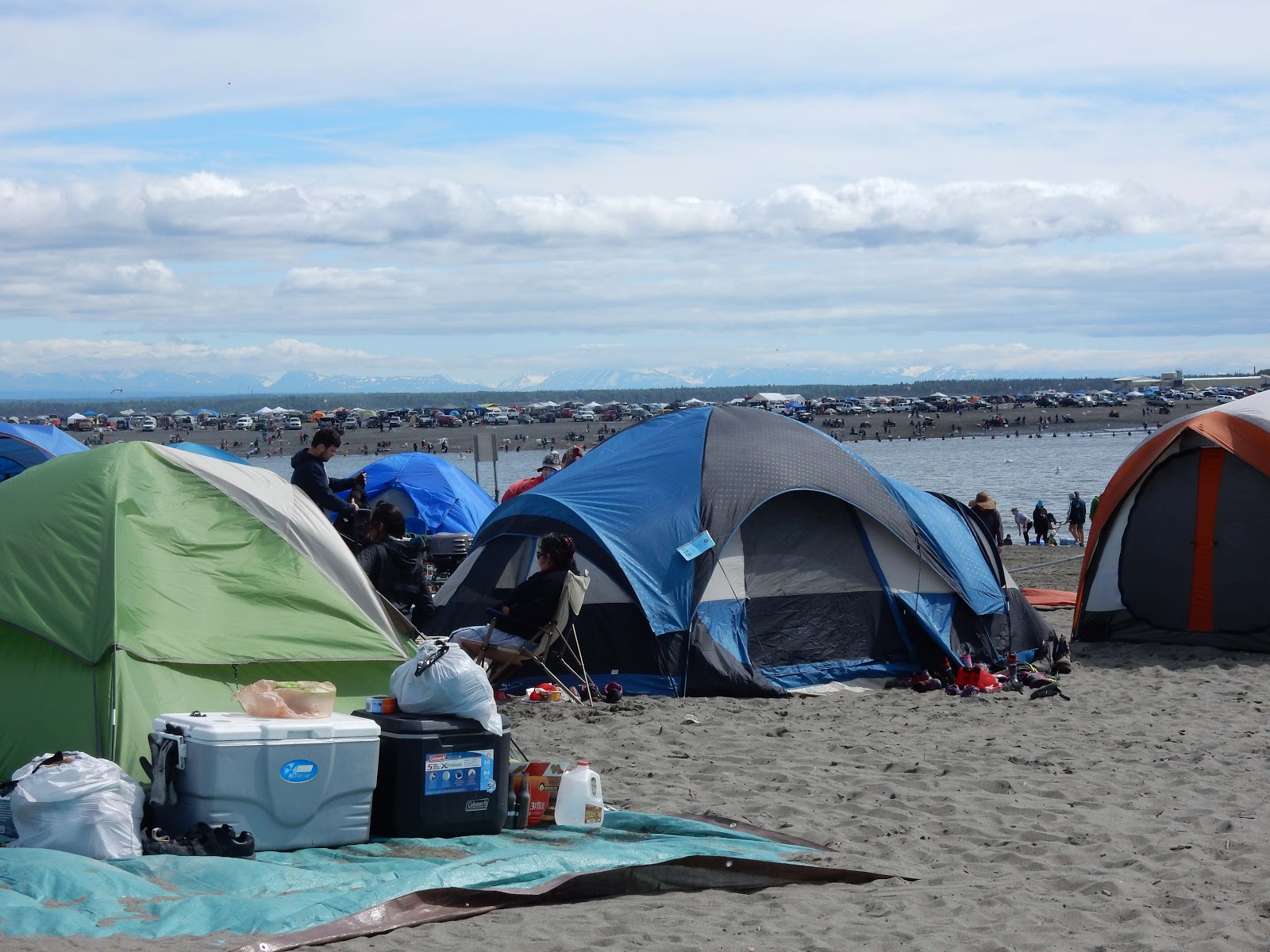

      Lots going on in this photo -- the guy in red is carrying his net, giving you an idea of its size. The rim of the net is at the left of the picture; the end of the pole  reaches just about to the right-hand edge. The kids are playing in the sand. Hundreds of people are sitting on the beach, walking around, and down in the water fishing. It's a curved bay, and you can see hundreds more people in the distance out in the water.

      Many people brought tents and RVs and camped for several days. All those cars parked on the bluff on the other side of the bay were a small part of the total. There were hot dog tents, football games,


dogs, various methods of transport,

and constant comings and goings.


      These kids were barefoot, playing in the surf, just as happily as if they'd been at a beach where it was 85 degrees instead of 65 and windy, and the water was more like 70 degrees than 40 degrees.

     Beyond it all, Mt. Redoubt loomed, less clouded than we've seen it all summer.

      We stopped at the Russian Orthodox church just above the beach, with its white picket gate, but no fence.

     The weather was even pleasanter in Homer, with less wind, but still enough for the para-sailors at the end of the Spit.

     We ate dinner at Land's End. Saw more people with fish they'd caught; these with rod and reel rather than dipnets.


     This little boy was part of  a family group that was leaving; his job was to carry the net, and he found an efficient way to do it.


     A sailboat on Kachemak Bay, with sunlight caught on the mountainside behind it.


        An eagle watching at Land's End; behind him and across the bay are the bluff and East End Road.

   
       A heart in the sand; appropriate for our 34th anniversary today.


     Evening shadows.

      Wild roses for the occasion.


     Just above and to the right of the couple on the beach is the hint of Mt. Augustine, a hazy dark spot. Maybe tomorrow we'll get a better view.