Wednesday, January 23, 2013

Toasted Israeli couscous with vegetables


                                                                               January 22, 2013


     The office potluck theme for January 23 was Middle Eastern. "Jerusalem: A Cookbook" by Ottolenghi and Tamimi (and listening to the results of the Israeli elections) inspired thoughts of  the small round couscous featured in Israeli recipes. The cookbook's recipe for salad didn't seem quite right for an Anchorage winter day; I wanted something warmer, so adapted this [vegan] recipe  from one posted by Claire Robinson on the Food Network in 2010.

Roasted Israeli cous-cous 

2 cups Israeli cous-cous
2 1/4 cups water
2 Tablespoons olive or other mild oil
Salt and pepper to taste
2 12 to 3 cups roasted vegetables
Lemon slices, cilantro for garnish

Heat the olive oil in a skillet. Add cous-cous and stir for 7 - 9 minutes, until it begins to brown lightly. Add the water (careful of the hot steam), and bring to boil. Reduce heat and simmer for ten minutes, or until the cous-cous is cooked through but still al dente.

I stirred in a cup of roasted cauliflower, about 1 cup of roasted zucchini, and about 3/4 cup of  roasted, diced red and yellow peppers, and seasoned with salt and pepper. Other vegetables would work equally well, as would chopped nuts or perhaps toasted pumpkin seeds.

This will spend the night in the refrigerator, and tomorrow, it can be served at room temperature.or heated through, with a garnish of cilantro and lemon slices.


Tuesday, January 8, 2013

The plains of Spain are mainly for the grains


                                                                                        January 8, 2013


Wheat along the margins of the Camino fields, September 5, 2012, between Fromista and Carrion de los Condes.


In September 2012, my husband, daughters and I spent a couple of weeks walking through wheat fields along the Camino Frances as part of our trek from Pamplona to Santiago. Before the Romans arrived around 100 B.C. E., the Celts walked west along this Camino Frances route to Finisterre, the end of the earth, the furthest west point that they knew. The Romans used the route for wheat fields, and to transport iron and gold east from the mountain mines to Rome itself. Around 450 or 500 C.E., the Visigoths came in and conquered the area, along with the rest of Spain, and ruled until the Muslims arrived in the early 700s C.E.  The Moors held most of Spain, including the Camino route, except for the northern sliver of Asturias that remained in the hands of the (by-then-Christian) Visigoths. In the early 900s, rulers in the north began to push the Arab conquerors south, and by 1492, Ferdinand and Isabella ruled all of Spain.

As we set one foot in front of the other along the dusty, rocky farm paths and country roads that now constitute most of the Camino, I wondered how it was that these fields had supported wheat crops for two thousand years. Or did they? My 4-H days in southwest Michigan taught me that without rotation and fertilizers, crops exhaust the soil. Did the Romans practice good agriculture routines? Did they even know about them?

The Camino Frances between Fromista and Carrion de los Condes, along harvested wheat fields, September 5, 2012.


It’s been difficult to find much information – they were the “Dark Ages” after all, and my Google searches have not always been the most brilliantly designed. The search query, “agriculture in northern Spain in the Early Middle Ages” has not been as productive as desired.

What I’ve been able to eke out so far suggests that once the Romans left, much of the area’s population did as well. The land devoted to wheat may have been used for smaller subsistence farms. At some point around the late 1400s, shepherds came in, and sheep laid waste to much of the land (Spain was noted for merino wool, and kept its monopoly until the mid-1800s by not allowing any sheep to leave the country). I always thought that shipbuilding for the Spanish Armada devastated the forests, but the sheep helped. Apparently, it’s only in the past 200 years at most that the Romans' fields have been planted to wheat again. Besides the wheat, in 2012 vineyards, corn and sunflowers competed for much of the land along the Camino.

Sheep between Fromista and Carrion de los Condes, on the Camino Frances, September 5, 2012.


As I get time to read more, I’ll come back to this topic, and share the news from the Early Middle Ages.


References: Empires of Food, by Evan D. G. Fraser and Andrew Rimas, 2010.  “Sheep and the Camino,” by E. O. Pederson, 2005, available online at  http://www.americanpilgrims.com/camino/essays/camino_sheep_rev.pdf


Roman road and bridge between Cirauqui and Lorca, about km 694 on the Camino Frances, August 28, 2012.


Saturday, January 5, 2013

What's up with wheat in 2013?

                                                                                                            January 5, 2013


Depends on who you ask, of course. Wheatavore checked out a few different sources, among them Huffington Post, Epicurious, and a couple of English web sites. HuffPost’s predictions for 2013 hedged their bets by tallying up forecasts from several other sites and showing those that made more than one list.

• HuffPost highlighted “Artisanal Bread at restaurants,” based on its mention by Baum and Whiteman, and Bon Appetit. About time? I have a stack of artisanal bread cookbooks and guides waiting to be read, so it’s been around for a while. But more restaurants – not just bakeries like Tartine, and locavore specialists like Faviken in Sweden –  are beginning to feature their own sourdoughs. Huff Post directs the reader to Baum and Whiteman’s site which notes that restaurants aren’t just setting out the bread – in European style, they’re charging for it -- but also offering more distinctive choices.

Artisan breads in a Santiago, Spain bakery, September 28, 2012.


Bon Appetit notes that bread is being served in new ways – “sourdough fried in pork fat and served with house-made butter.”

Agreeing with HuffPost, Etai Baron, co-CEO/founder, Udi's Foods Local says that Northern European breads – of the sort popularized by Noma in Denmark, Faviken in Sweden, and Tartine in the U.S. – will be more prominent than the breads of the Mediterranean. The northern breads tend to be sourdoughs, and often use a wider variety of grains, mixed in with the wheat flours.

• HuffPost also highlights another Bon Appetit trend, grind your own grains for those baking at home. Some stores sell bulk grains and have mills on-site. Hand or motor-driven mills are also available for home use. You can experiment with different blends of hard and soft wheats, colored wheats, or blends of grains. Or you can go locavore, growing your own wheat or finding a nearby source, and milling it yourself to get the freshest and most intimate terroir.

• A web site devoted to fast food restaurants suggested that places like Wendy’s are beginning to serve sandwiches on more exotic breads, including flatbreads. “During its investor day in June, Gerard Lewis, Wendy's senior vice president of Culinary Development, said he wants to be the first to market flatbread. . . . Wendy's also is exploring other types of breads such as a cheddar/jalapeno bun and a pretzel roll.”

• Epicurious offers its own set of predictions, some of which involve wheat. For example, we will be creating snacks at home, such as Vanilla Snack Cakes to make up for the loss of Twinkies [which I predict will be back on the market within the next twelve months, perhaps with a different name or a new manufacturer, but we aren’t likely to be deprived of our favorite non-food treat for long].

• In England, Lost in Catering is big on food trucks (which some U. S. websites think are so 2012 or even 2011), and new ways to wrap foods: “. . . Meats are increasingly being wrapped with Turkish pizza or stuffed Naan to add flavour.” The food trucks experiment with Chinese bao (dumplings) filled with more Western meats, and fusion choice such as “roti rolls,” a mix of Turkish and Indian foods, the roti being an Indian flatbread. For seated dining, sourdough pizza rules. [I have to make a personal pitch here for Rocca, a Kensington pizza place that we ate at in November 2011 with dough made from a “naturally yeasted” wheat and spelt mix – full of flavor, but not sour.]

• Another United Kingdom site suggests that American baked goods will give way to British traditions, especially regional baked goods – most of which I don’t recognize, but will have to research – “We're moving away from American-inspired bakes, such as whoopie pies, towards British ones. Maids of Honour, Bath buns, parkin, pikelets, Singing hinnies, Staffordshire oatcakes . . . there’s a rich national heritage to be explored.” Any national heritage that include Singing hinnies surely needs more attention. [Turns out that they are a kind of griddle cake, rather like a fried scone, made with flour,butter and/or lard, milk, sugar, and currants. They "sing" as they sizzle on the pan; "hinny" means honey -- affectionate slang for something sweet.]


Friday, January 4, 2013

314Pie food truck -- Aussie pies on wheels


                         January 3, 2013
Savory pies to go.
Picture

People have been selling food on the streets for as long as there were streets. Food trucks take it to the next logical level. Why hawk your wares on a corner when you can find another corner with no competition and bigger crowds?

It’s not quite so simple these days as harnessing the donkey to the cart and plodding off. There are health departments, and tax collectors, business licenses, and food suppliers to please and pay off. Not to mention letting your fans know which street corner you’re at today through FaceBook, Twitter, and blogs.

Last summer, Casey Cooper and Deke Kotrla got started on their Seattle version of Aussie pies with 314Pie in Seattle. By November of 2012, they were driving their brilliantly blue converted van (unmissable against Seattle’s too-often gray skies) and selling out their savory and sweet pies to hungry crowds.

The pies themselves belong to a tradition as ancient as food vendors. Call them pasties, Cornish pies, calzones, pierogies, dumplings, tiropitas, burritos, tamales, samosas, wraps – most cultures that have breads have figured out a way to wrap dough around something tasty to make a portable meal. Wheat flour lends itself especially well to encasing foods. The stretchy gluten networks formed by wheat when it meets water mean tender crusts that don’t overwhelm the fillings with dense or tough outer walls.

Deke and Casey have been experimenting with the pies favored by Aussies and New Zealanders. For the holidays, their goose, apple and walnut pie captured the season. In the new year, vegetarians get mac and cheese with peas, or black-eyed peas and greens based on Deke’s Southern heritage,. The black-eyed peas bring good luck for the New Year; carnivores can get them with the traditional ham hock. More 2013 pies include steak and onion or steak and mushroom pies that feature local grass-fed beef. Mac and cheese with pancetta show an Italian touch. Earlier in the year they had minestrone pie, vegetable curry, and pork and peach, and they continue to experiment with locally-sourced ingredients and different cuisines. The sweet offerings to start off the year include apple and caramel pie, walnut butterscotch, cinnamon fries, and chocolate chip cookies.

Check out their current menus, and their daily schedule, and try some soon.

314Pie at South Lake Union.
Picture


Thursday, March 22, 2012

Peak experiences -- Flour plus butter

Veggie galette -- just ready to bake.

One of the high points of cooking is the chance to combine butter and flour. Add a bit of water, maybe salt, maybe yeast -- all very simple, but with the right techniques amazing things result. With five-minutes, and the right temperatures, you get delicate, flaky pie crusts; with yeast and a lot of time and effort, croissants are born. In between is a rolled pastry crust that I discovered recently that takes advantage of techniques from both ends of the spectrum.

Published in Cook's Illustrated ( January-February 2012 issue), I also found it on-line in a slightly different version. In both places it was being used for a galette, an open-faced tart that can be filled and topped with veggies, or can go sweet with fruits. Custards (eggs and milk combinations) sometimes add to the fillings, binding the ingredients, and giving extra richness. The pastry starts with more of a pie crust approach, cutting in very cold chunks of butter to flour. It switches to a croissant or puff pastry approach by then chilling the dough, and rolling it out, then folding and rolling, folding and rolling, until it's a many-layered splendor. A final chilling and rolling gives a flaky puff pastry crust with a buttery croissant taste.

My filling used a mix of sauteed and roasted vegetables -- roasted cauliflower and roasted red peppers with sauteed onions and garlic. Fresh frozen peas from the Matanuska Valley, tossed in just before baking the galette, provided color and summer flavor. I experimented with the cheese filling/binder as well, using a half cup of ricotta, a quarter cup of parmesan, and a quarter cup of heavy whipping cream. Next time I'll make more cheese,using 3/4 or a full cup of ricotta, a little more parmesan, and enough more whipping cream to give it all a slightly flowing consistency.

Here's the pastry dough recipe, quoted from the Macheesmo site, with my notes added in brackets:

Ingredients (from Macheesmo website, http://www.macheesmo.com/2012/01/mushroom-and-leek-galette/)
Dough:
1 1/4 cups (6.25 ounces) all-purpose flour
1/2 cup (2.75 ounces) whole wheat flour
1 tablespoon sugar
1 teaspoon kosher salt
10 tablespoons unsalted butter, cold and cubed
7 tablespoons ice water
1 teaspoon white vinegar

Making the dough:

Phase 1:
"Start the dough by mixing together your dry ingredients in a large bowl and then mix in the cubed butter with your fingers. You could use a food processor for this, but I like using my hands. Just get the butter into pea-sized pieces and then add your liquid.
Once your liquid is added, stir it together, but don’t over-work it. There’s no need to bring the dough completely together at this point. The word Cook's Illustrated used to describe the dough is 'saggy.' I prefer the term 'crumbly.' . . .
Scoop this crumbly dough out onto some plastic wrap, wrap it very tightly and refrigerate it for about an hour." [You can refrigerate it overnight too, if that's more convenient.]
Phase 2:
"Once your dough has rested for an hour in the fridge the flour will be better hydrated and it’ll be closer to one full piece when you unwrap it."
 [Mine wasn't even close to one full piece -- it was still a pile of crumbles. I followed the advice I'd read somewhere to add driblets of ice-cold water, continuing to mix until the dough sticks together just enough so that you can roll it. Altogether, I probably added another 1/4 cup - 1/2 cup of water. You may have to do this too - not because there's anything wrong with you or the recipe but because flours are very different in their gluten contents, and in their ability to absorb water. There's no way to tell this ahead of time, so just be comfortable with this particular batch of dough.]
"Roll it out on a well-floured board to form a long rectangle. It should be about 8×14 if you want to get specific, but I just eyeballed it [Macheesmo has photos, if you want to check out that web site]. Then fold the bottom 1/3 of the dough up to the center. . . . Then fold the top 1/3 down . . . . This basically creates three layers of dough.
Rotate the dough 90 degrees and do the whole rolling and folding process again. For those that aren’t math inclined, the second time you do this, you’ll have 9 layers of dough (3×3). The third and last time you do this, you’ll have 27 layers of dough.
This makes the final dough very flakey and awesome and is worth the 10 minutes or so it takes to do it. Your final dough will be really easy to work with. Before you roll it out though, wrap it in plastic again and stick in the fridge for another hour so it firms up."
Filling:
Now's a good time to make the filling, while waiting for the dough to chill the second time. You also could make the filling a day ahead if preferable. I t comes in two parts -- the veggies, and the cheese mixture.
Veggies: Cut a head of cauliflower into about one-inch pieces, or break it into that size florets. Evenly coat with two tablespoons full of olive oil; salt and pepper lightly. Roast them in a preheated 450 degree oven for 15 to 20 minutes, until browned and tender. While the cauliflower is roasting, saute two minced cloves of garlic and 1/4 cup minced onions or leeks (white parts, with a little of the green, as preferred) for four to five minutes in one tablespoon of olive oil. Combine the roasted cauliflower and sauteed garlic and leeks with one cup of fresh raw peas, or frozen peas. Add as much as one cup of other sauteed veggies and/or mushrooms. I used about three-quarters cup of roasted red peppers that I had previously frozen.
Cheese mixture: Mix together one cup ricotta cheese, one-quarter to one-half cup parmesan cheese, and about one-half to three-quarter cup of heavy cream. If you like, mix in a beaten egg.
Phase 3, Dough:
Preheat your oven to 400 degrees. Take your dough out of the fridge a few minutes before you want to roll it out [Cook's Illustrated suggested 15 to 20 minutes. I had guests and wasn't thinking -- I just took the cold dough out and started rolling. Tough work! But eventually I got the 14" circle, 1/8" thick I bought a silicone pastry mat with sizes marked on it -- it was a great purchase]. Then roll it into a large circle. Ideally, it would be about a 14 inch circle, but you can just eyeball it. I do recommend taking a knife and actually cutting a round shape out of the dough if you have any ends that are sticking out because it will make the folding easier [put the trimmings on the baking sheet and you'll end up with delicious little rich pieces of pastry to nibble on the next day -- if the rest of the people in the house haven't finished them off].
Transfer the dough to a [rimmed] baking sheet lined with parchment paper and brush the center with some olive oil."
Phase 4, Some assembly required:
Pile one-half of the filling on the dough, leaving about three inches all of the way around, for folding the dough up over the filling. Layer on about one-half of the cheese mixture, the remainder of the veggies, and top with the rest of the cheese mix. 
Next, the galette part -- folding up the dough around the edges to make an attractive edging that holds the filling in. Take an edge of the dough and fold it up over the filling. Move about three inches, pick up the edge, and overlap it on the earlier piece and the next bit of filling. Continue this way all around the galette. When you're finished, you'll have dough overlapping the filling all of the way around, and an open space about six inches in diameter in the center so that you can admire the filling. Beat an egg lightly and brush it over the turned-up edging.
Now, the baking -- turn the oven down to 375 degrees (if you don't, the galette will cook too quickly, and the parchment paper will overheat and burn). Bake for 35 to 40 minutes, until the filling is bubbling and the crust is nicely browned.
This will serve four as a main course, or six as a side. 
What else can you do with a galette?
Any sort of vegetable or meat filling that you might use for a savory pie can be adapted to a galette. Here's a link to a zucchini and asparagus galette. You can use sweet fillings, fruit fillings, custard fillings -- anything that will go into a pie crust will go into a free-form galette. The zucchini and asparagus recipe also uses a much simpler crust, more like a standard pie crust, without the puff pastry emphasis on chilling and layering the butter and flour.

A March evening in Alaska -- one right setting for a galette.


Saturday, February 25, 2012

London Breads Around the Town


London had as many delicious breads as Barcelona, although the settings were not as elegantly Art Noveau (in Spain, called "Modernisme"). Here are a few:


These first three are from the Food Halls at Harrod's.


Foccacia at Harrod's.


Breads and pastries in the Harrod's Food Halls.


A cake in a pastry shop in the Covered Market in Oxford.


Giant gingerbread men, cookies and kitsch at the Oxford Covered Market.


Naturally yeasted breads at the Borough Market, Southwark, London.


Cheeses at the Borough Market, to go with your bread.


Pigeons near the Borough Market, eager for some bread crumbs.


Thursday, February 23, 2012

Barcelona Bakeries


   Barcelona is noted for chocolate, the 1992 Summer Olympics (and for wanting to be a contender for the Winter Olympics a few years hence; it is building an indoor ski resort, harvesting the cold from the transport of liquified natural gas to make the snow), and Gaudi's buildings variously described as hallucinogenic, bizarre, and world treasures. It also has one of the world's great street markets all along Las Ramblas, and bakeries everywhere. Our November 2011 two weeks there had more than its fair share of rain, but plenty of chances to sample breads and pastries that could hold their own compared to  any place in Europe.

My favorites were whole wheat croissants topped with toasted sesame seeds sold from Rocamora Forns, a small shop across the narrow alley from the St. Josep Market. We often were there too late to buy any -- I wasn't the only one in Barcelona who loved them. Many of the regular croissants were finished off with a sweet glaze, not to my taste. The breads were delicious too, and came in a full range from seed-chocked health foods to delicate white breads with thin crackling brown crusts.

The "peasant bread," "pan de tomate," was made with a ciabatta-like white bread, sliced thin and sometimes toasted. First, it's rubbed with a cut clove of garlic, then with a halved tomato, so that some of the pulp is left on the rough surface, and finally drizzled with olive oil. With luck, and a good enough restaurant, the waiter brings the makings, prepares the first slice before you as an example, and then leaves you to do the rubbing and drizzling yourself for the remainder. You get to do all of the eating, too. It was one of the best things in any bar or cafe, and also one of the cheapest.

Here are photos:

Barcelona bakery.

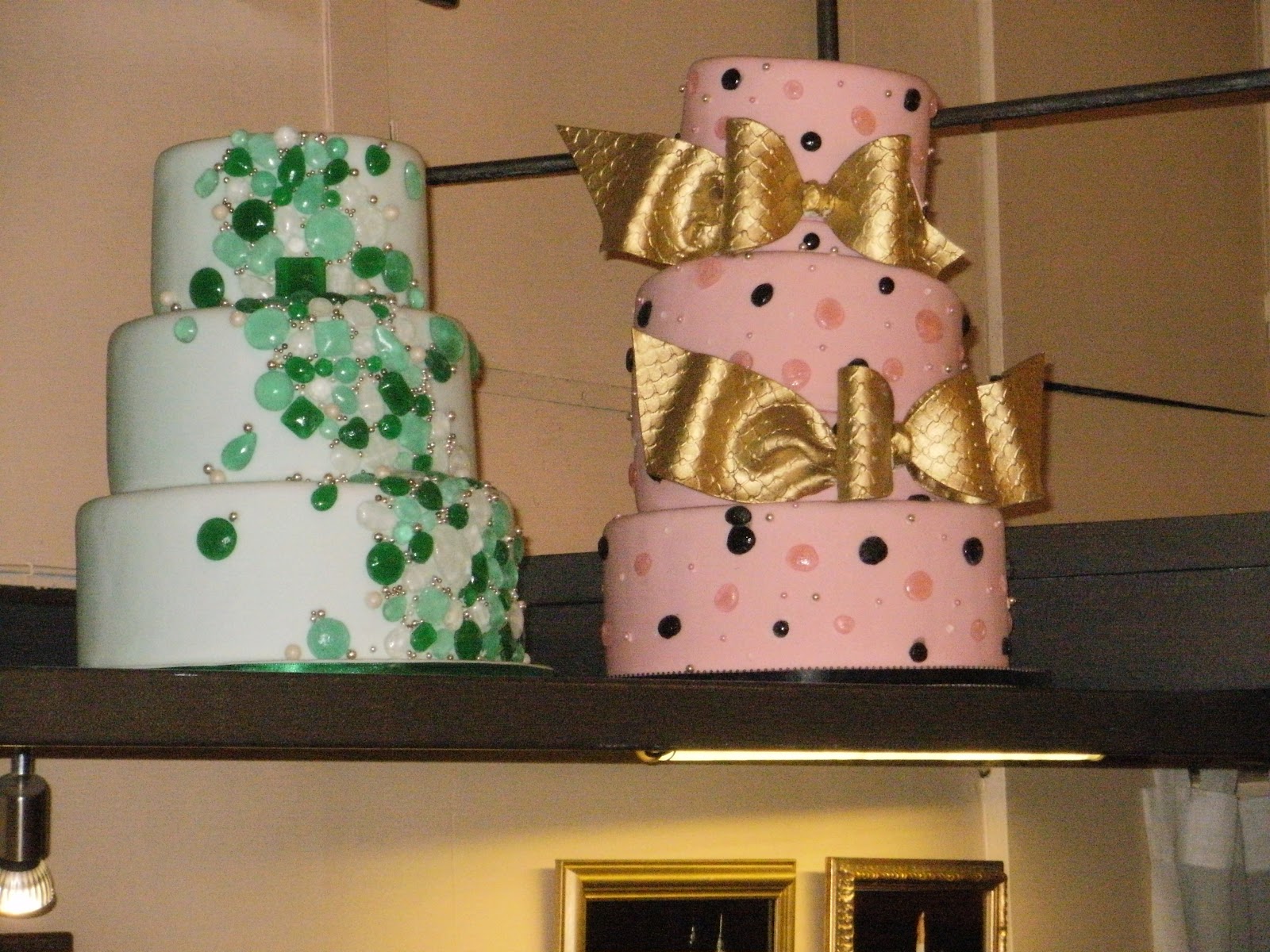
Escriba pastry shop on Las Ramblas, famous for its decorated cakes.

A day's haul -- cookies, a min-chocolate croissant,a roll to eat with butter and cheese.

A fruit tart, glazed, and centered with cherries.

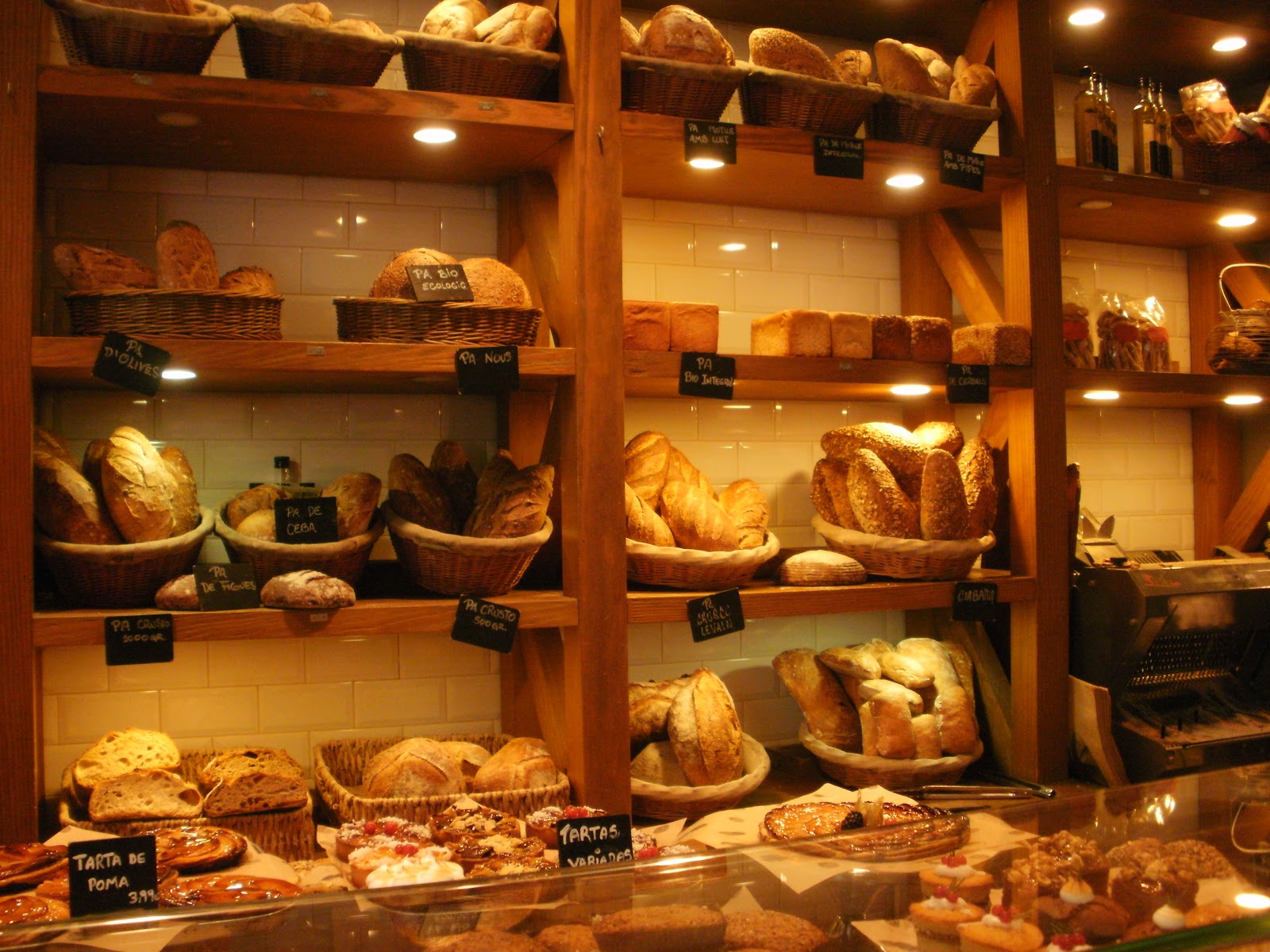
Barcelona bakery, with a variety of naturally yeasted breads.


Presentation is all: a carrot cake; brownies, up by the peppers and potatoes on the top shelf, croissants at the lower left in a flower pot. Pastry shop in L'Eixample.

Escriba pastries -- plain croissants, filled croissants, something like palmiers.


The pastry shop in the St. Josep Market off Las Ramblas, that is home to the whole wheat croissants.

The Art Noveau (Modernisme) Wheat Goddess outside Escriba.